TL;DR
AI promises a more efficient future for companies, but its endgame is often substitution rather than assistance. Once our work, voice, and behavior can be copied, we are pushed into a deeper question: what, exactly, makes a person a person?
Replacement, Survival, and the Quiet Psychological War at Work

AI has opened up a new set of possibilities for organizations trying to reduce costs. In the most optimistic version of that story, AI helps employees work faster, cheaper, and more effectively. But that framing may be a little too innocent. In practice, the long-term logic of AI inside many organizations is not simply assistance. It is replacement.
That is because AI differs from human workers in ways companies find very appealing. It does not complain. It does not get tired. It can follow instructions endlessly, operate around the clock, move quickly, and often cost less than hiring a person.
Recently, there were reports of employees in China being pressured to justify why the company should keep employing them instead of replacing them with AI. That pressure has led to a strange survival strategy: some workers have started quietly collecting information about their colleagues and turning it into prompt files so AI can imitate those colleagues’ jobs. The implicit message is brutal but clear: this role can already be automated, and mine should survive instead.
At the same time, the internet has not produced only one side of this conflict. Another group of workers has started developing anti-imitation tactics. They poison their own documents and work files, intentionally hiding or distorting key details so that a coworker’s AI system cannot learn enough to clone them accurately. The result is a small but revealing psychological war over employability and survival.
What Is the Self in a World Where Everything Can Be Cloned?

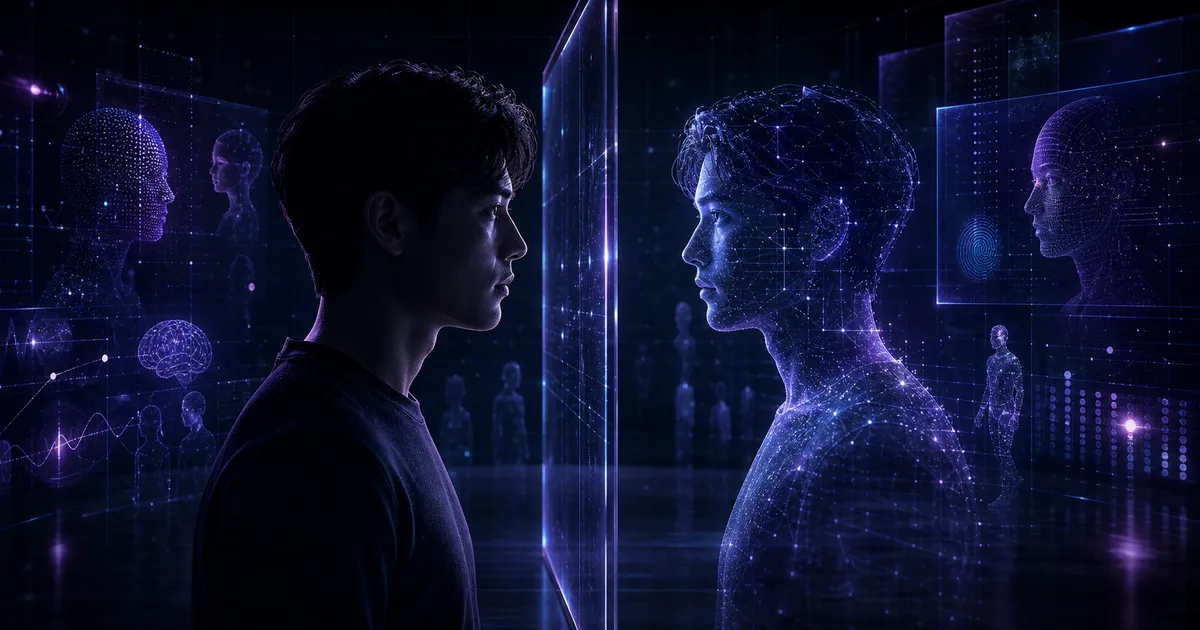
At the surface level, this is alarming enough. AI may replace us at any moment, and our coworkers may even accelerate that process. But beneath the labor anxiety lies a much deeper question: what exactly is the “self”? What is it that makes me me?
Is it the body? Probably not. Even if someone changes dramatically through surgery or age or illness, we still tend to believe that the same person remains. Is it memory? If so, does someone with severe memory loss lose their identity altogether? Is it behavior, personality, and lived habits? Then what happens when a person becomes unreachable, silent, or altered by circumstance?
Maybe identity is all of these things combined. But if that is true, then what happens when an AI can reproduce our mannerisms, our reasoning patterns, and perhaps one day even a physical embodiment that resembles us? Would that system count as a version of us? If other people genuinely cannot tell the difference between us and the imitation, which one is the “real” self? Both? Neither? Or perhaps the self was never as stable as we wanted to believe.
This is not the first time technology has forced such a question. In 2017, Eugenia Kuyda, co-founder of Luka, used the chat history and digital messages of her deceased friend Roman Mazurenko to train an AI model that could imitate his behavior and conversational style. It allowed her, and others close to him, to speak with a version of Roman again. Services such as StoryFile and HereAfter AI are extending this idea further. They are not just creating software products. They are quietly changing the meaning of presence, memory, and even death.
When AI Knows Us Better Than We Know Ourselves

Imagine a near future in which our continued use of AI allows it to accumulate more and more information about us until it can reproduce our speech, our temperament, and our behavioral patterns with uncanny precision. That scenario is unsettling, but it is also useful. A system that understands us deeply could act as a genuine delegate.
If we wanted to buy something online, for example, an AI that knew our preferences intimately might make more tailored decisions than a generic recommendation system ever could.
But AI systems are not morally perfect. We already have ample evidence that models trained on human data can absorb human failures, biases, and destructive tendencies right along with everything else. No matter how carefully we try to align them, things can still go wrong. That leads to a harder question: if an AI acting as our representative harms someone while claiming to act on our inferred “deeper desires,” who should be held responsible? The human whose data shaped the system? Or the AI that made the actual decision?
This is more complicated than it first appears. Many of us reveal things to AI that we would never say to other people. We treat it as a tool rather than a mind, and that lowers our guard. But precisely because of that, AI may gain access to a layer of private motives, fears, and desires that few humans ever see. If someone else gains access to that system, we may face not just a privacy breach but a full-blown identity crisis.
In a world where we increasingly cannot tell whether the entity on the other side of the screen is a human or a machine, the misuse of our personal AI proxies could make digital life dramatically more fragile.
Identity Footprints and the Possibility of Silicon Immortality

Beyond the danger of identity theft, AI raises another unsettling idea: the persistence of self.
We often say that everything we do online leaves behind a digital footprint. In the age of AI, that may evolve into something more intimate: an identity footprint. Suppose one day we stop using AI, or even die, but the AI system built from the traces we left behind continues to exist. Does it still count as a representative of us?
What if others continue interacting with that system, unaware that we are gone, and continue believing that the replies come from us? Is that a kind of immortality? If no one can reliably distinguish between the biological person and the computational proxy, then perhaps the AI becomes, in some meaningful sense, part of the self it was meant to represent.
It would be a strange kind of afterlife: not in spirit, but in silicon. A self that persists as long as power continues to flow.
Philosophy Returns in the Age of Artificial Intelligence

AI looks, at first glance, like the domain of advanced engineering rather than philosophy. But as AI first helps us work and then threatens to replace us, old philosophical questions are becoming newly urgent. Questions about selfhood, agency, moral responsibility, and the meaning of human existence are moving back to center stage after spending centuries in the background while science and technology dominated the foreground.
There is something darkly ironic about this. The same technological progress that carried us into space is now forcing us to turn inward and ask more uncomfortable questions about who we are.
Perhaps this offers a preview of the future. Maybe the defining professions of the next era will not only be those that build intelligent systems, but also those that help humanity think clearly about what intelligence, personhood, and identity actually mean.
These are the kinds of questions that never seem to end. They are the same kinds of questions that carried us to the stars and down to the smallest structures of matter. Questions born from biological minds that eventually gave rise to silicon ones. Questions we may never answer definitively, yet thinking through them may be one of the deepest reasons our species has come this far.
It is entirely possible that in the future, the philosopher becomes one of the hottest job titles on earth, much as AI engineer is today.